
A picnic lunch on the cliffs and an afternoon walking between La Corbière and Le Gouffre. The smartest insect on show was a female Eupeodes corrollae, a species of hoverfly and thanks to Jody Roberts for the correct ID. Some overflies are straightforward, others are a nightmare. They are a delightful group of insects and I have started a separate page for them which will be added to as summer progresses. This individual was patiently feeding on an Ox-eye Daisy and didn’t flit off when I knelt down with the camera which was very obliging of her. The sexes can be told apart by looking at the eyes: those of a male hoverfly meet in the middle whereas there is a gap between those of a female. Maybe she has a bigger brain…
The main job of the afternoon was to continue to flag the nest sites of the Black-backed Meadow Ant, Formica pratensis. Wendy Bramall recently illustrated one as part of a commemorative set of Guernsey stamps celebrating endangered species.

The afternoon got off to a great start as I found a new nest a short way down the path from the car park at La Corbière heading towards Le Gouffre. This area has become a stronghold for the species, some of the nests are the biggest in the island. Nearer Le Gouffre, there is a path that leads out to a viewpoint and yet another nest, first seen by Andy Smith, which has yet to be recorded. This one is not new as it is a good size, about 45cm across, and aleates, or winged ants, were emerging. this is a clear sign that the nest is established.

I learned last year that the Scarce Seven-spot Ladybird, Coccinella magnifica, can often be seen near these ant nests. I have no explanation for this, I would have thought that as ladybirds eat aphids the ants would see them off but there is no doubt that over the past four years I have often seen ladybirds, and Lesser Bloody-nosed Beetle, Timarcha goettingensis, close to many of the nests. The Scarce 7-spot is scarce. Andy Smith recorded Guernsey’s second sighting earlier this month and I promised that I would keep an eye out.
Ladybirds are not easy to examine, especially in the vicinity of feisty ants and last time I was out I failed miserably as any ladybird just fell into the undergrowth when I tried to pick it up. This time, I went with one of my moth pots and it worked. The photos are cloudy because of the plastic, but below is a Scarce 7-spot which I found right by an ant nest near Le Gouffre.


From Le Gouffre, I walked back through the lanes. I had to stand out of the way of a tractor and trailer which had knocked down a flower spike from a Horse Chestnut tree, Aesculus hippocastanum. I took the opportunity for a close look.

A little research confirmed my observation that the newer flower, with the fresher stamens is yellow while the older flower with the stamens turning brown, has turned pink. This flower has been pollinated and no longer needs to attract pollinating insects. The yellow colour of the fresh flower is, presumably, advertising that it has pollen/nectar available. Science aside, they are very pretty flowers. On the same flower stalk, developing fruit could be seen.
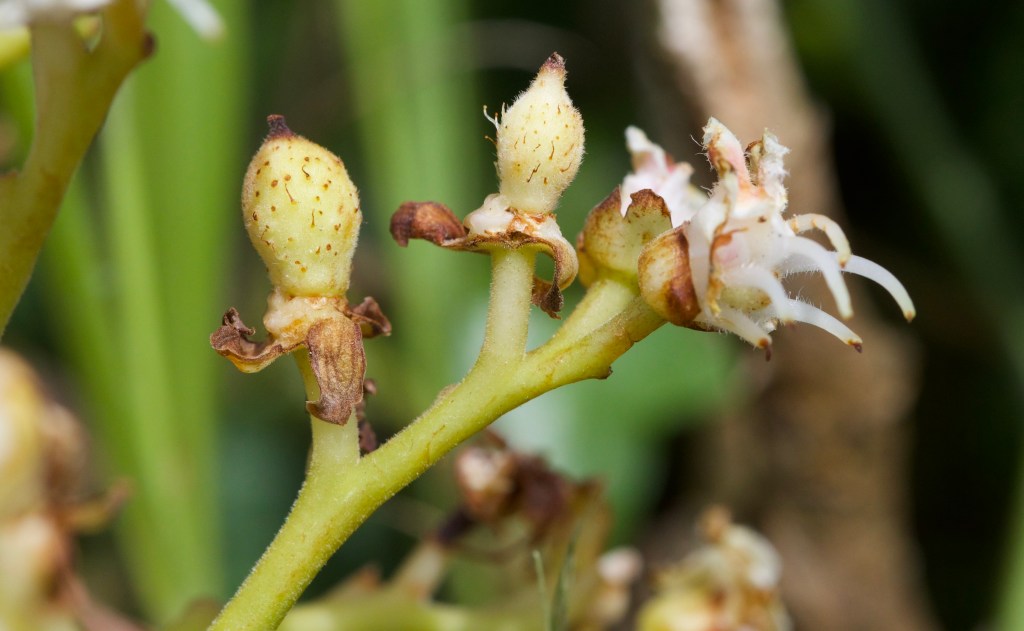
Horse Chestnuts are not native to Great Britain. They were introduced by John Tradescant the Elder who brought back six conkers from Turkey early in the seventeenth century. He had to wait several years after germination for the saplings to grow big enough to bear flowers and produce their own conkers.
 Natural history of the Bailiwick of Guernsey