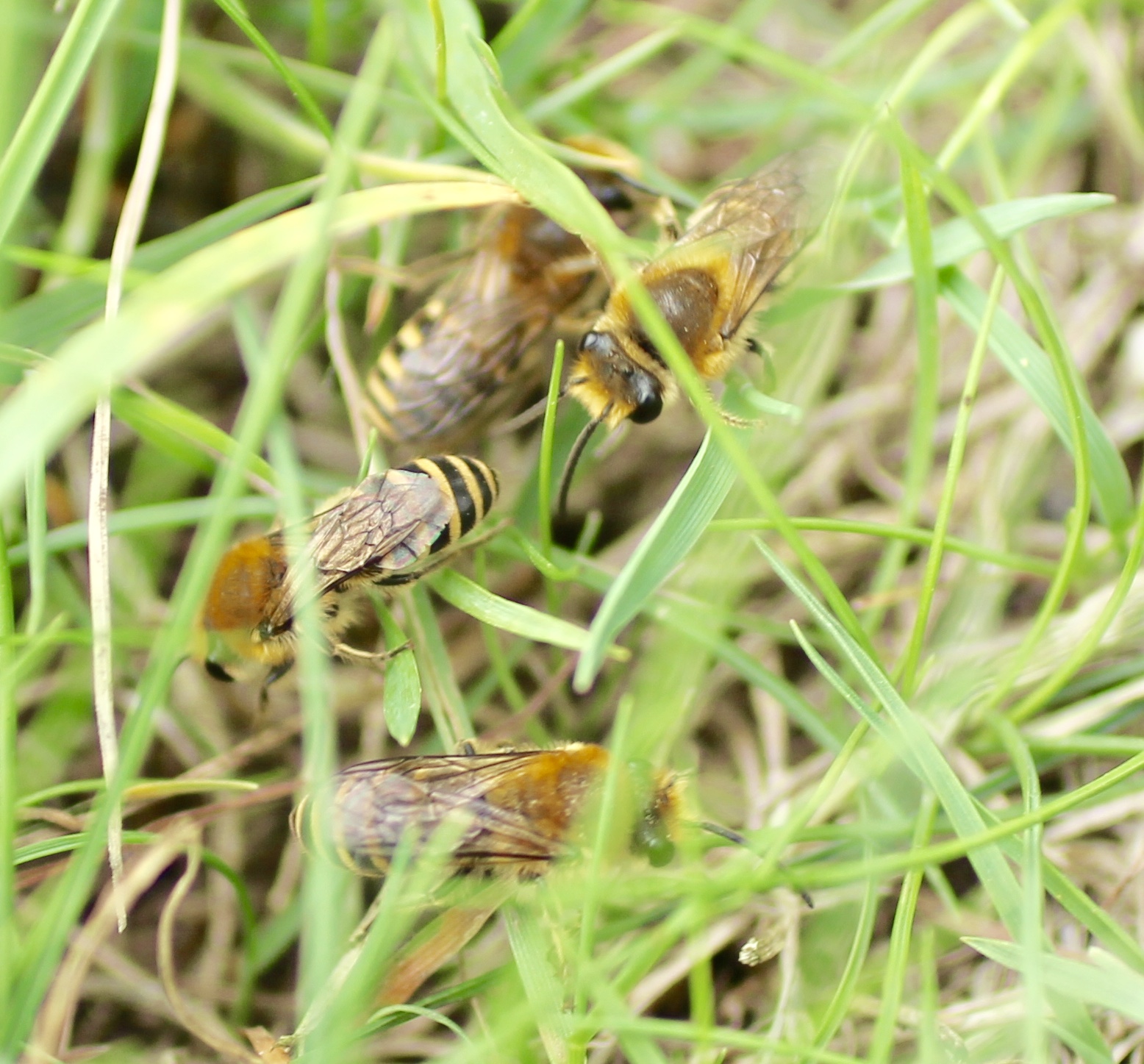
I have a grass path outside the front door and every year round about now Ivy Bees emerge from their underground nests. These will be the females as they hatch out a few weeks later than the males. The cat finds them very disconcerting as over thirty bees zoom around the grass at his ankle height. He avoids the path wherever possible, not realising that these bees are almost harmless. The males have no sting. The females do have a sting but rarely use it, the venom is much weaker than that of a honey bees and the Ivy Bee is far more even tempered.
They nest in colonies in sandy soil where vegetation is sparse – parts of my garden are ideal as my soil is basically earth coloured sand, with a fair sprinkling of limpet shells. Ivy Bees have been recorded in the Channel Islands since the 1970s. They have been present in my garden since at least the late 1990s when I moved here. The bees will be on the wing until October, with a few going through to early November.
Their emergence is, for me, a seasonal marker like the first returning Swallow in spring. Today was the first day that I have seen them, although I did see some feeding on ivy at Pleinmont on 13 September. Autumn is here.
Their flight period is very late to coincide with the late flowering of ivy. Ivy will have its own entry in the plants section as it is a hugely important wildlife plant. As a gardener I used to weed it out. As a wildlife gardener, I encourage it. The Ivy Bees feed on the nectar and pollen – together with a host of other insects. Red Admirals come to ivy in great numbers.
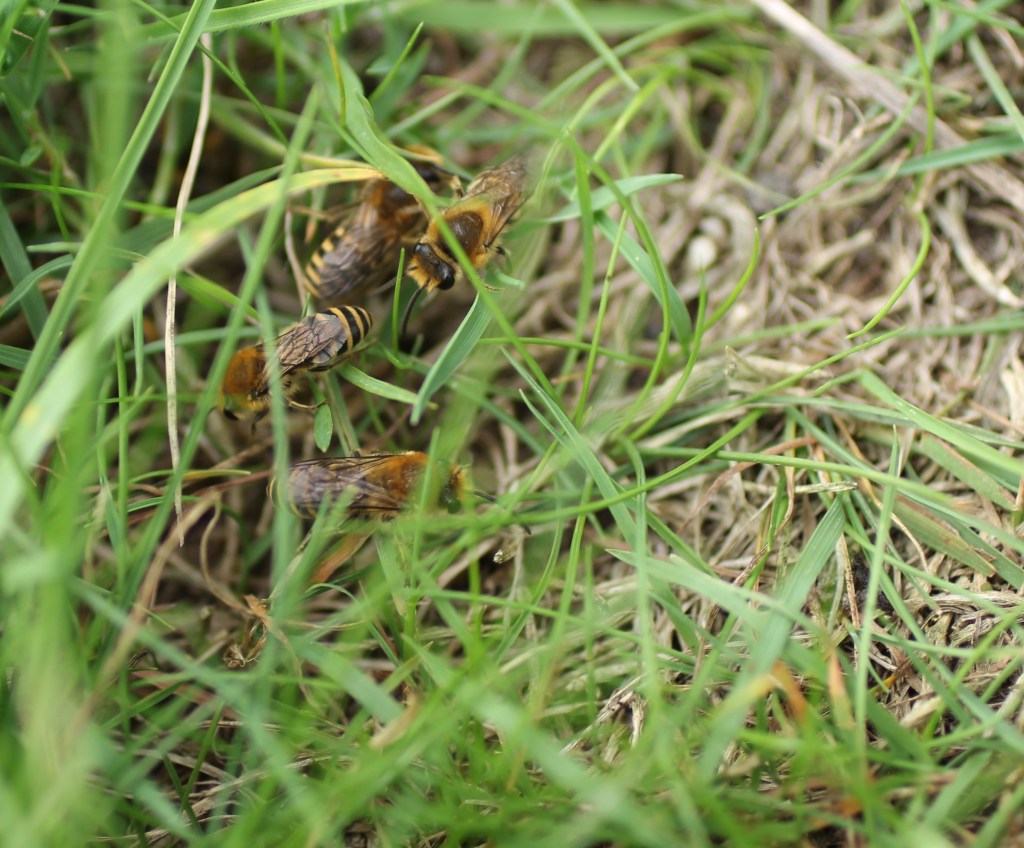
They are speedy customers and not easy to photograph. Both photos show a mating ball – the males jockeying around a tunnel where a female is emerging.
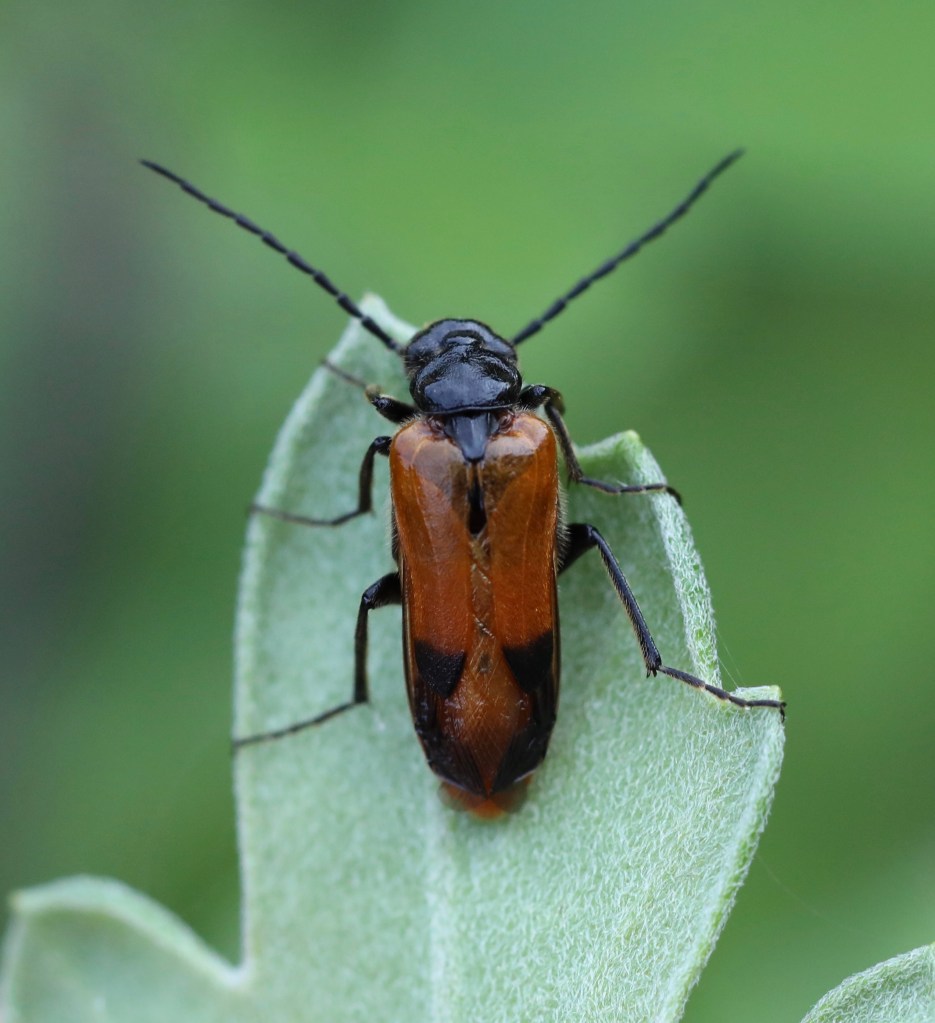
Ivy Bees are parasitised by a beetle, Sternoria annals. I have seen this species in my garden before the females emerge. The beetle larvae give off a pheromone which mimics that of the female Ivy Bee. Male bees are attracted and the larvae attch themsleves to the bee’s body. If that bee mates, the larvae are close enough to move across on to the female’s body and they are then taken back to the underground nest. They move from the bee to the nest wall. It will stay there over the winter, eating the bee egg and its supply of pollen before hatching out the following summer. The temptation is to destroy the parasite, but it is all part of the natural world so the beetles are left. My little colony of Ivy Bees seem to thrive despite the attentions of Sternoria analis. I have simplified its life cycle, but like the ivy, I will create a separate page to show how amazing these invertebrates are.
 Natural history of the Bailiwick of Guernsey