Saturday 29 May

A picnic lunch on the cliffs and an afternoon walking between La Corbière and Le Gouffre. The smartest insect on show was a female Eupeodes corrollae, a species of hoverfly and thanks to Jody Roberts for the correct ID. Some overflies are straightforward, others are a nightmare. They are a delightful group of insects and I have started a separate page for them which will be added to as summer progresses. This individual was patiently feeding on an Ox-eye Daisy and didn’t flit off when I knelt down with the camera which was very obliging of her. The sexes can be told apart by looking at the eyes: those of a male hoverfly meet in the middle whereas there is a gap between those of a female. Maybe she has a bigger brain…

The main job of the afternoon was to continue to flag the nest sites of the Black-backed Meadow Ant, Formica pratensis. Wendy Bramall recently illustrated one as part of a commemorative set of Guernsey stamps celebrating endangered species.

The afternoon got off to a great start as I found a new nest a short way down the path from the car park at La Corbière heading towards Le Gouffre. This area has become a stronghold for the species, some of the nests are the biggest in the island. Nearer Le Gouffre, there is a path that leads out to a viewpoint and yet another nest, first seen by Andy Smith, which has yet to be recorded. This one is not new as it is a good size, about 45cm across, and aleates, or winged ants, were emerging. this is a clear sign that the nest is established.

An maleate, or winged ant

I learned last year that the Scarce Seven-spot Ladybird, Coccinella magnifica, can often be seen near these ant nests. I have no explanation for this, I would have thought that as ladybirds eat aphids the ants would see them off but there is no doubt that over the past four years I have often seen ladybirds, and Lesser Bloody-nosed Beetle, Timarcha goettingensis, close to many of the nests. The Scarce 7-spot is scarce. Andy Smith recorded Guernsey’s second sighting earlier this month and I promised that I would keep an eye out.

Ladybirds are not easy to examine, especially in the vicinity of feisty ants and last time I was out I failed miserably as any ladybird just fell into the undergrowth when I tried to pick it up. This time, I went with one of my moth pots and it worked. The photos are cloudy because of the plastic, but below is a Scarce 7-spot which I found right by an ant nest near Le Gouffre.

Scarce 7-spot Ladybird. The two dorsal spots are noticeably bigger than the other spots.

From Le Gouffre, I walked back through the lanes. I had to stand out of the way of a tractor and trailer which had knocked down a flower spike from a Horse Chestnut tree, Aesculus hippocastanum. I took the opportunity for a close look.

Horse Chestnut flowers showing colour change before and after pollination.

A little research confirmed my observation that the newer flower, with the fresher stamens is yellow while the older flower with the stamens turning brown, has turned pink. This flower has been pollinated and no longer needs to attract pollinating insects. The yellow colour of the fresh flower is, presumably, advertising that it has pollen/nectar available. Science aside, they are very pretty flowers. On the same flower stalk, developing fruit could be seen.
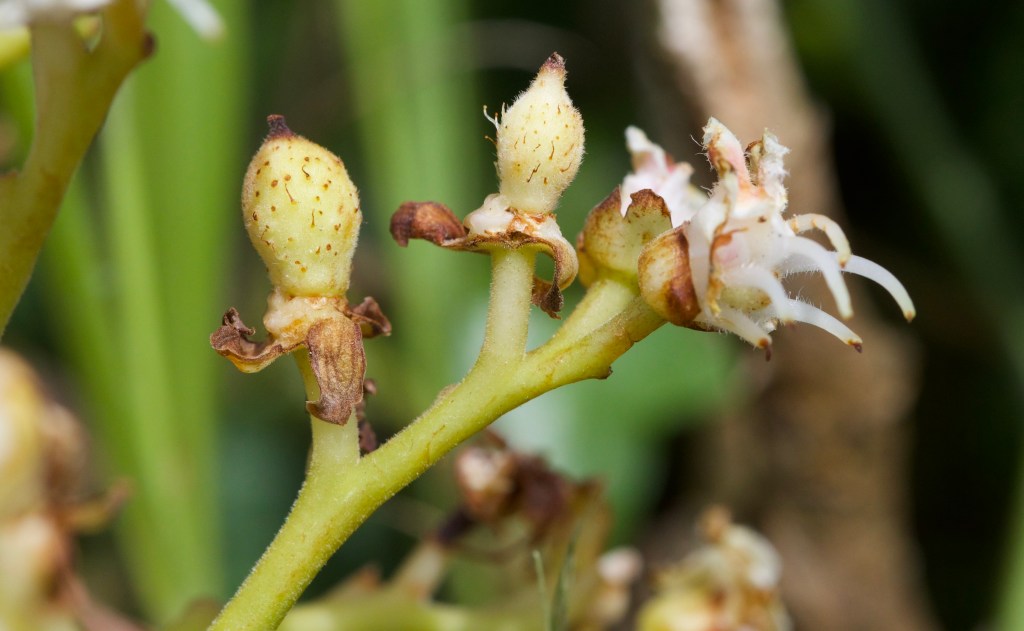
Horse Chestnuts are not native to Great Britain. They were introduced by John Tradescant the Elder who brought back six conkers from Turkey early in the seventeenth century. He had to wait several years after germination for the saplings to grow big enough to bear flowers and produce their own conkers.
Thursday 27 May

This year, spring has been very late in coming. April was cold and dry with persistent north-easterly winds, May has been cool, grey and cloudy with some very wet days so moth trapping has been disappointing to say the least. The only consolation has been that low numbers and few species have been the story across the UK with many complaints about frequent frosts.

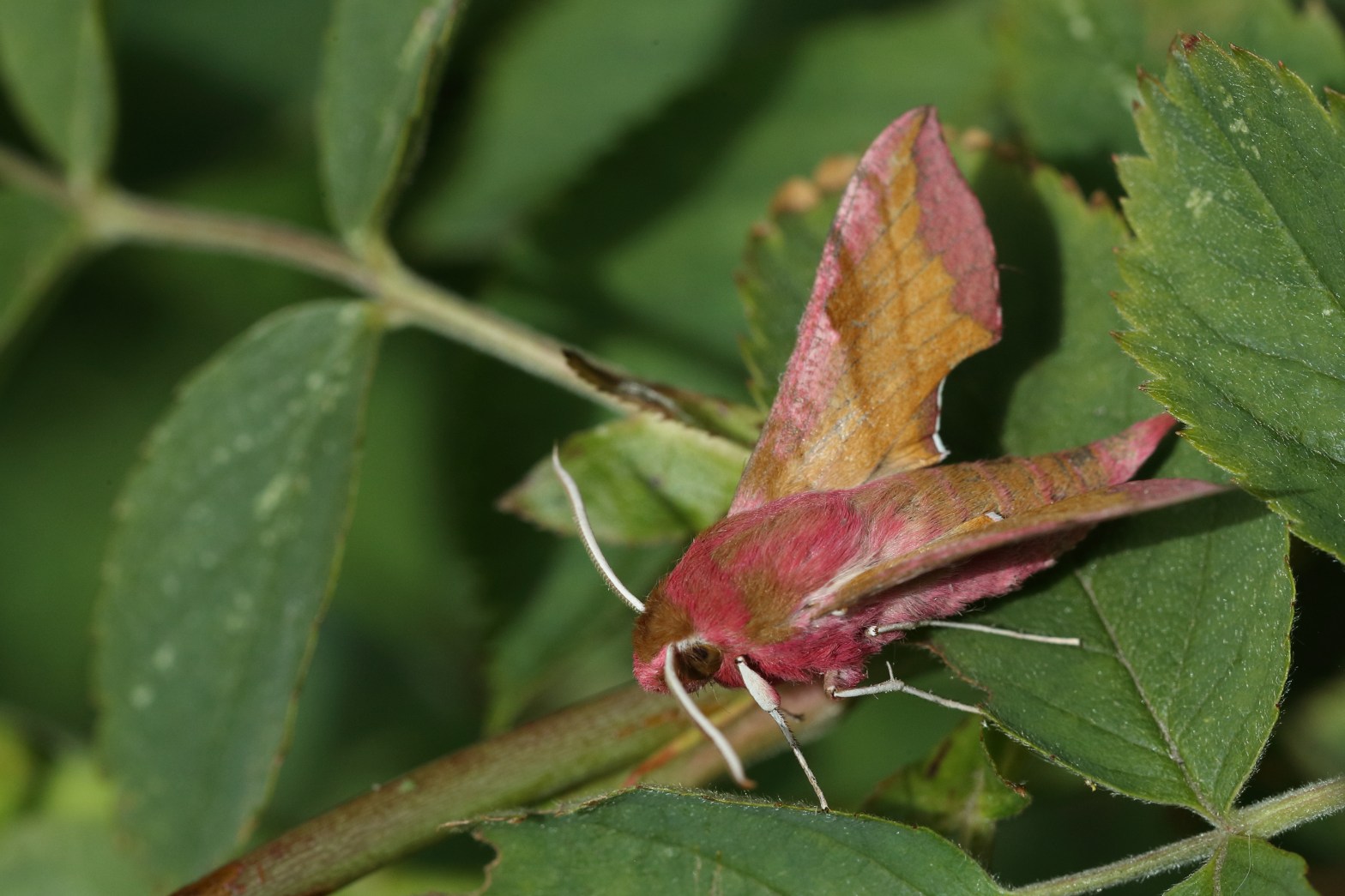
Last night was the first time I crept up to double figures for the number of species (10). The star was a Small Elephant Hawk-moth especially as it was a life tick for me and confirms how vauable it is to have a moth trap. Essentially, you turn on a light source which attracts many moths – but not all – and have a special box or container with egg cartons inside. The moths fly into the container and rest on the egg cartons. These are then examined the next morning and all the moths are recorded. They then rest up during the day and fly off unharmed. Although this species is common in Guernsey, I had never seen one before. What a moth! To find out more information about this species click on ‘Moths and Butterflies’ on my homepage.

I am new to mothing and only became interested a few years ago when a neighbouring family put out their trap. I offered to take photos to get some of the species identified – there are excellent groups on Facebook and Twitter. The close-up views opened my eyes to how beautifully marked moths are. Some are like the best quality Persian rugs. Last summer I bought my own trap with an actininc bulb and now am persuading myself that an MV trap is worth the expense. These use mercury vapour bulbs which are far more powerful and attract a wider range of moths. The downside is they are not as envrionmentally friendly and a time will come when MV bulbs will no longer be available.

In the meantime, it’s great to know that temperatures are rising as we’re nearly into summer and there will be plenty more mornings when looking into the trap is just like unwrapping Christmas presents as you just don’t know what’s inside. Today, the Small Elephant Hawk-moth was a five-star present.

I’m also looking forward to some mothing events with the Entymological Section of La Société Guernesiaise this summer. Different habitats have different moths so there will be an evening when traps are used at Le Grand Pre which is an area of reedbed close to where I live – mozzy repellant to the fore.

There will probably be an outing to Herm in the summer – bending double over the thyme on Herm Common looking for some Pyrausta species: Pyrausta ostrinalis and Straw-barred Pearl Pyrausta despicata. After all that, lunch at the Captain’s Table will be very welcome.

Straw-barred Pearl, Despicata despicata. Torteval, guernsey 2017

12 – 15 May – Alderney

The blog has had to wait until I returned home to Guernsey as I forgot to pack the power cable for my laptop and I defy anyone to use WordPress on a mobile phone. This trip was booked a few months ago as a short Staycation and the chance to do a little bird ringing with John Horton, Warden of the Alderney Bird Observatory, https://alderneybirdobservatory.org

Britain’s most southerly bird observatory, John was instrumental in getting this project off the ground in 2016. Supported by companies such as Zeiss and Naturetrek, the observatory has contributed important data through ringing and recording. It has benefited the island by bringing in birdwatchers, particularly in the ‘shoulder’ months when there are fewer tourists. It has also been of immense benefit to the Channel Islands Bird Ringing Scheme.

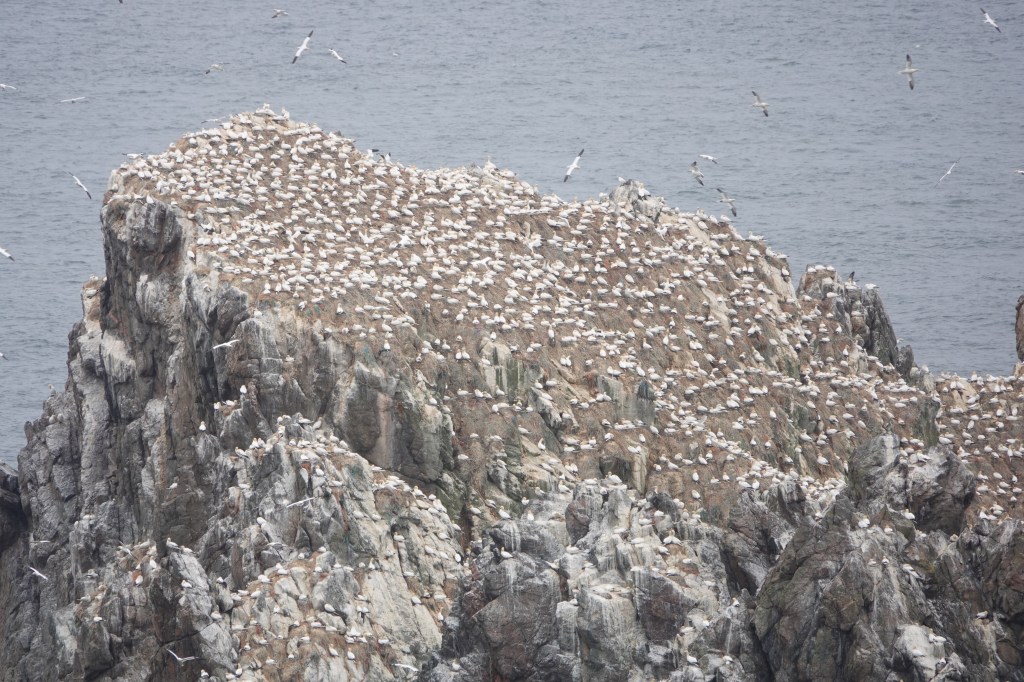
This trip was my first visit for many years and the must-see were the ganneteries on Les Etacs, rock stacks off Alderney’s south-west tip. Coming out of the airport, the sign post points right for St Anne’s (Alderney’s town) and left for Gannets! In 1945 there were only a handful of birds but this number has now grown to over 6,000. These rocks are at the southern edge of their breeding range and they are now full, as is nearby Ortac.

Les Etacs from Giffoine. There is a fixed telescope to get really good views.
Les Etacs, Gannets are present in numbers between February and November every year.
A closer look shows fishing rope is collected by the birds in significant amounts for nesting material. A number of birds die every year as a result of becoming entangled.

The bird ringing did not quite go to plan. It rained on the first full day, a few hours on the second day produced meagre results and on the last day it was too windy to put up most of the nets so we packed up and did an hour’s birdwatching instead. On Friday evening, Matt, the ABO’s Assistant Warden took me to the hide at Longis Pond to watch the Swallows coming in to roost in the reeds. What a sight in the fading light to see well over a hundred circling and flickering over the water before finally coming in to take shelter in the reeds. Some were netted and these were ringed back at the Nunnery, together with a Sand Martin. My ringing rate was rather slow as they have such tiny legs.

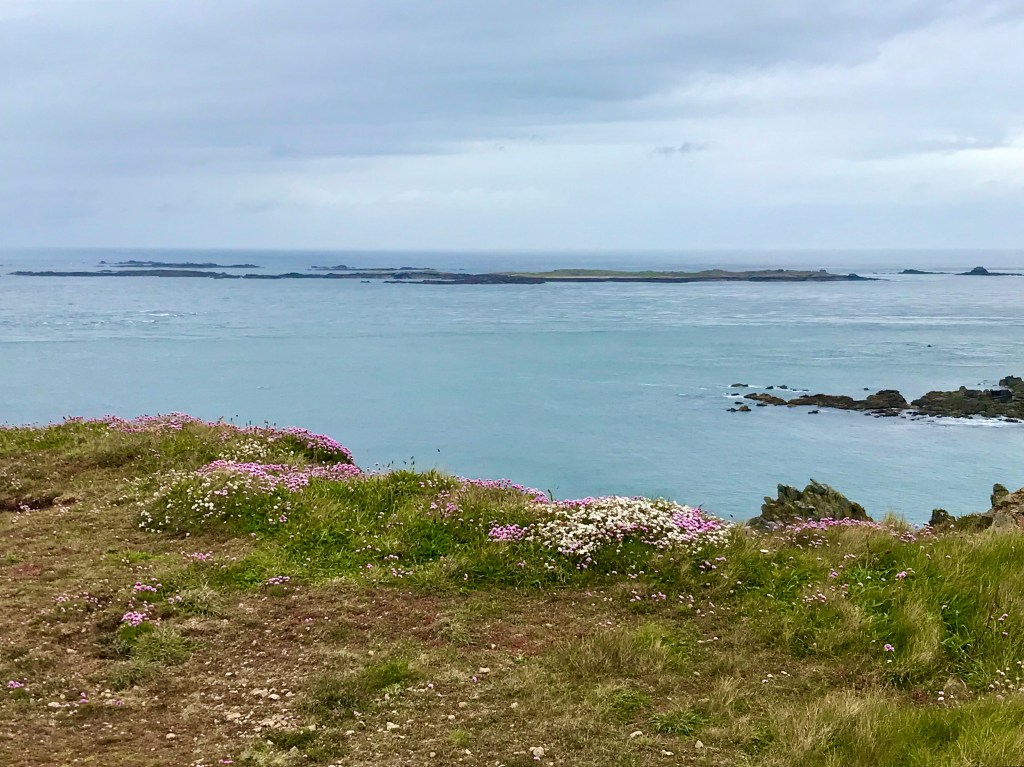
Between Giffoine and Fort Clonque – Alderney has more fortifications than you can shake a stick at thanks to the Brits in the nineteenth century and Nazi Germany in the twentieth – there is a coastal walk along the cliffs.

Fort Clonque

The gorse this year has been stunning and interspersed with good patches of heather this is a great area for birdwatching. Ian Le Page, who had been helping the ABO with its daily census, kindly showed me the patch where Dartford Warblers had been seen. Having spent time in Sark back in the autumn (blowing a hooley) and again in the spring (cold) I had only succeeded in hearing a brief snatch of song. With time to spare on Friday, after an early morning ringing session, I went to investigate.

Giffoine looking out to Burhou

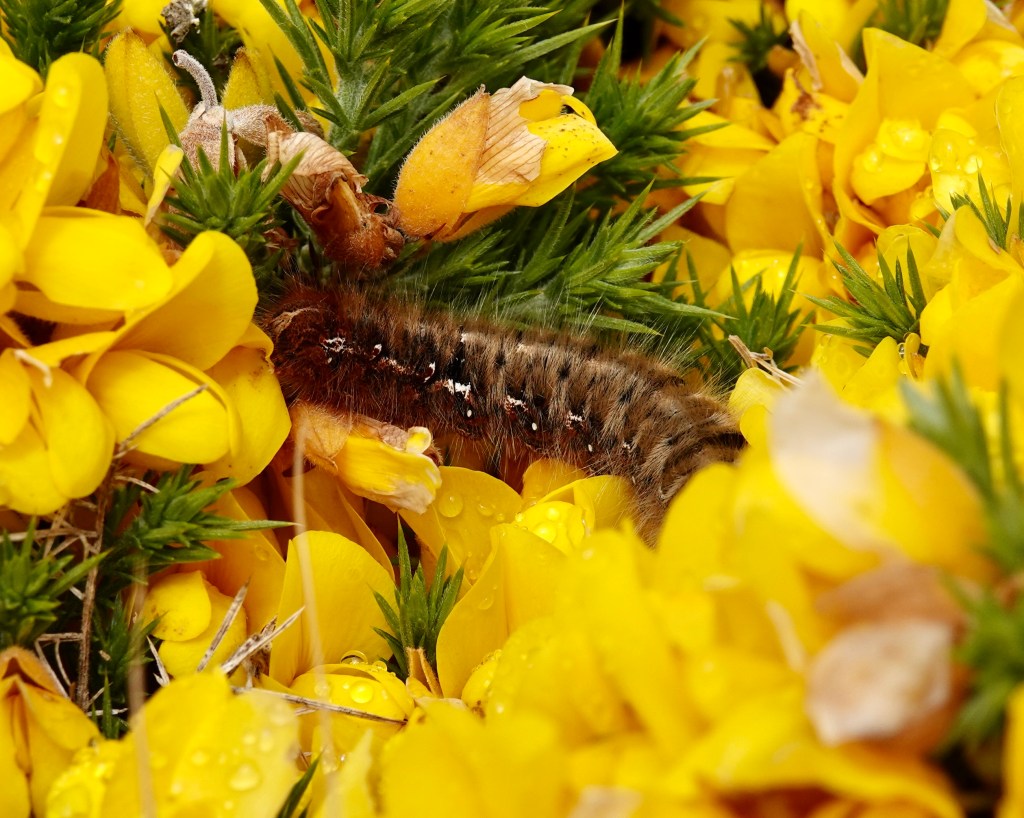
First up were a couple of caterpillars. My knowledge of caterpillars is woeful, so I’m hazarding a guess that the first one is the larva of an Oak Eggar. The second one? I haven’t a clue, so I’ve posted on the excellent Facebook Group, Insects of the Channel Islands so will label it when I get some replies. Andy Smith posted this reply: I think this is The Drinker 66.010- Rich’s list shows it as listed for Guernsey in 1899, no further records, one Herm record in 2003, but common in Alderney. We are so fortunate to have some very knowledgeable people, not just in the Bailiwick but in Jersey as well.

Possible Oak Eggar larva
Mystery larva? – no longer thanks to Andy Smith – it is a larva of The Drinker

Then I mis-identified a male Stonechat for a male Pied Flycatcher – my excuse is that the light was against me and it really did look just black and white. Back in Guernsey yesterday I looked at the photo and realised my mistake – record corrected. One that needed no correction was the Cuckoo which was calling and seen in flight three times. There were good sightings of Whitethroat, their scratchy song attracting my attention.

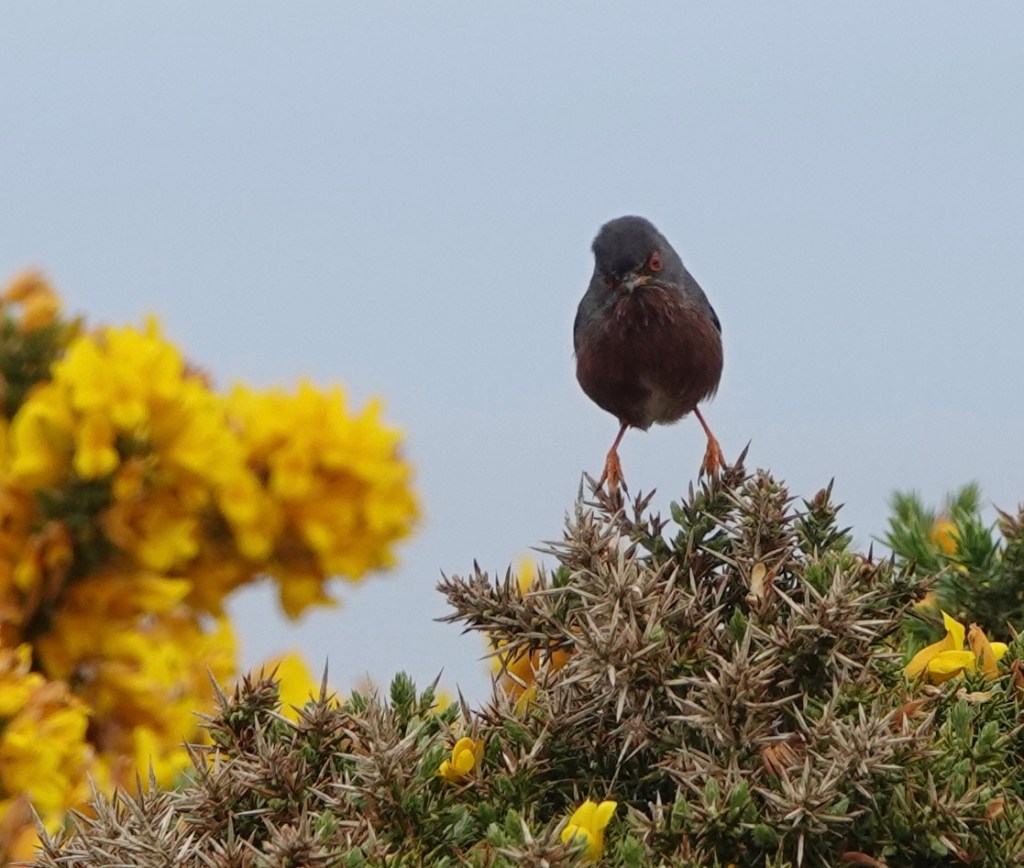
Best of all was – yessss – Dartford Warbler. Again, their scratchy staccato call, although rather quieter than I thought it would be, attracted my attention. They are not shy birds and showed up well with tail cocked and that red eye. Watching from a distance and keeping still, I enjoyed their company for about twenty minutes before walking on to leave them in peace.

Cocked tail and red eye – they are not shy. Best view of a Dartford Warbler I’ve had since they were breeding in Guernsey before some very cold winters in the 1980s
How to perch on gorse – very carefully on tiptoe. No wonder he looks cross.