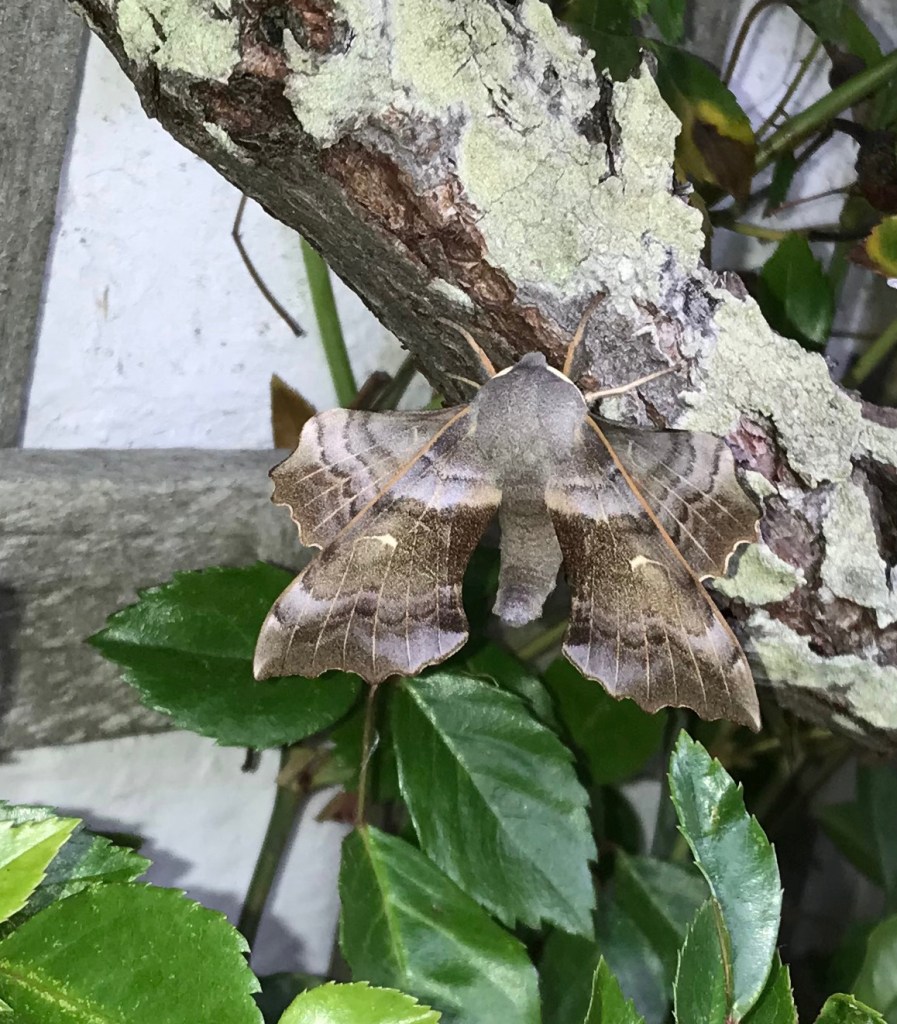
I first saw one of these resident moths in the garden when my neighbours ran a Robinson moth trap back in 2018 and I began to appreciate how many more moth species I would see using a trap. I now regularly see 5-6 of these stunners every June/July. The flight season is from May through to July/early August, Sometimes there is a second generation from August through to September. The forewing can measure between 30 – 46mm which makes it one of the larger moths.
The individual in the photo, taken on 03.06.21, showed lilac tones on the fore and hind wings. They look extraordinary because when resting the hind wings come to the front. they look as though they have no business to be flying at all, but the family name of hawk-moth is given because they are good flyers and quick to manouevre in the air. When at rest, they are content to stay where they are and can be handled with care. So this one I was able to place on a more natural background than a pot or my blue towel. It was a male as its abdomen curled up at the end.
GB Staus: Common – of all the Hawk-moths this is the most frequent and widespread.
Foodplants: Larvae feed on Poplars and Willow, including Grey Willow which is native to Guernsey and abundant in low-lying areas. Poplar Hawk-moths belong to the Smerinthinae group. The proboscis is small and the adult moths do not feed – I assume this means that they have a very short life on the wing.
Habitat: In areas where there are poplars or willows.
Also recorded in Alderney.
 Natural history of the Bailiwick of Guernsey